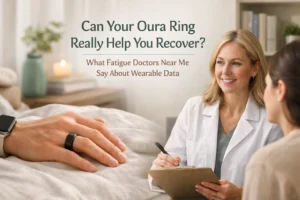
Can Your Oura Ring Really Help You Recover? What Fatigue Doctors Near Me Say About Wearable Data

Doctor discussing the impact of Oura Ring on fatigue recovery with a patient.

Can Your Oura Ring Really Help You Recover? What Fatigue Doctors Near Me Say About Wearable Data

Wearables didn’t show up out of nowhere. Over the last decade, consumer health tech shifted from “step counting” to continuous recovery tracking: sleep stages, HRV (heart rate variability), temperature trends, and readiness scores. Now patients in Memphis, Collierville, and Germantown walk into visits with dashboards and graphs and ask the big question:

Can my Oura Ring (or Whoop, Garmin, Apple Watch) actually help me recover from chronic fatigue?

Here’s the fatigue-clinic answer: wearables are useful. They are not a diagnosis. They can help you pace, identify patterns, and avoid obvious overtraining. But real recovery: especially from chronic fatigue: requires a biology-based plan that looks for root causes and corrects them.

At The Fatigue Clinic (located in Collierville, serving Germantown, Memphis, Arlington, and surrounding areas), we’ve done this work for 16 years. We use data. We also know exactly where data can mislead you.


What your Oura Ring is actually measuring (and what it’s not)

Most wearables estimate recovery through a bundle of signals:

  • Sleep timing and continuity (how long you slept, awakenings, efficiency)
  • Sleep staging (light, deep, REM: estimated via movement + heart signals)
  • Resting heart rate (RHR)
  • HRV (heart rate variability)
  • Respiratory rate (varies by device)
  • Skin/body temperature trends (Oura is known for this)
  • Activity load (steps, strain, workouts, recovery balance)

Oura combines key data into a Readiness Score (0–100). In general:

  • Higher score = your body looks more recovered
  • Lower score = your body looks stressed and may need rest

This can be helpful because it’s objective, consistent, and trend-based. But it is also limited. Wearables are not measuring things like:

  • Thyroid output and conversion issues
  • Iron status (ferritin) and oxygen-carrying capacity
  • Nutrient deficiencies (B12, folate, vitamin D, magnesium)
  • Hormone patterns (cortisol rhythm, sex hormones)
  • Immune activation, chronic infections, inflammation
  • Blood sugar instability and insulin resistance
  • Gut dysfunction and microbiome imbalance
  • Sleep apnea (they can hint; they don’t diagnose)

If you’re searching “fatigue doctors near me” because you feel exhausted every day, this is the missing piece: wearables are the “smoke detector,” not the fire investigation.


The best-case scenario: how wearables do support chronic fatigue recovery

When used correctly, wearables give three major advantages.

1) They create a simple “pacing guardrail”

Chronic fatigue often worsens from boom-bust cycles: you feel okay, do too much, crash, repeat.

A wearable can help you see early warning signs:

  • RHR trending up
  • HRV trending down
  • Temperature trending up
  • Sleep becoming fragmented

Those trends can be a signal to pull back before you crash.

Action: If your HRV drops and RHR rises for 2–3 nights, keep the next day low demand: basic movement, hydration, simple meals, no intense workouts.

2) They show “invisible stress”

Many patients in Memphis and Germantown tell us, “I’m not stressed.” Then their data shows:

  • Short sleep
  • Late bedtime drift
  • Elevated nighttime heart rate
  • Minimal deep sleep

That doesn’t mean you’re doing something “wrong.” It means your nervous system is running hot. A wearable can make that visible.

3) They help confirm what works

When you make changes: light exposure in the morning, consistent bedtime, lower evening alcohol, earlier dinner: wearables can show:

  • Better sleep continuity
  • Lower RHR
  • Improved HRV trend

That feedback improves follow-through because you’re not guessing.


The downside: why readiness scores can be misleading for chronic fatigue

Here’s the part most device marketing doesn’t say.

Wearables are calibrated on healthier populations

If you have chronic fatigue, post-viral fatigue, fibromyalgia, autoimmune issues, or ME/CFS-type symptoms, your body may not follow “normal” patterns.

Real-world reports show that some people feel awful while their wearable reports “optimal readiness.” That mismatch can happen because:

  • Sleep staging is an estimate, not a direct brainwave measurement
  • “Readiness” is built for training guidance, not complex chronic illness
  • Some conditions involve non-refreshing sleep even with “good” duration
  • You can have a “decent” night and still have immune, metabolic, or hormonal drivers of fatigue

Bottom line: Don’t let a score tell you you’re fine when you’re not. Use the score as a data point, not a verdict.

Wearables can push perfectionism

If you’re already tired, the last thing you need is anxiety about:

  • “I only got 1:12 of deep sleep”
  • “My HRV is low again”
  • “My readiness is 58: now what?”

For some patients, that constant monitoring increases stress, which worsens sleep, which worsens fatigue. It’s a real loop.

Rule: If the wearable makes you more anxious, take breaks. Use it in focused “check-in seasons,” not 365 days a year.


What fatigue doctors look at first: the “signals behind the signals”

When someone in Collierville calls and says, “My Oura data is bad and I’m exhausted,” we think in layers:

Layer 1: Recovery behaviors (the obvious wins)

  • Sleep schedule consistency
  • Morning light exposure
  • Evening screen/light reduction
  • Protein intake and meal timing
  • Hydration + electrolytes
  • Activity pacing (not zero, not overdoing)
  • Caffeine timing (not after late morning)
  • Alcohol frequency (often a sleep wrecking ball)

Layer 2: Physiologic stress load

  • Blood sugar swings
  • Inflammation
  • Overtraining / under-recovering
  • Undiagnosed sleep breathing issues
  • Medication/supplement side effects

Layer 3: Root cause biology

This is where chronic fatigue typically lives:

  • Thyroid dysfunction
  • Iron deficiency (low ferritin)
  • Nutrient depletion
  • HPA axis dysregulation (stress hormone pattern problems)
  • Gut dysbiosis and absorption issues
  • Chronic immune activation
  • Mitochondrial dysfunction patterns (cellular energy bottlenecks)

Wearables don’t replace this work. They can support it.

![Root Cause Discovery: Quick Facts Sheet

How we use wearable data at The Fatigue Clinic (Collierville)

At The Fatigue Clinic, we integrate wearables as part of a bigger plan. The goal is simple: turn data into action, then confirm improvement with trends.

Step 1: We define your baseline

We look at 2–4 weeks of:

  • Sleep duration and consistency
  • RHR and HRV trends
  • Temperature trends (if available)
  • Activity patterns

Not one night. Not one score. Trends.

Step 2: We match your symptoms to your pattern

Example patterns we see often in Memphis-area patients:

  • High RHR + low HRV + frequent awakenings → stress physiology, overreaching, stimulant timing, inflammation
  • Normal sleep duration but “never refreshed” → root-cause physiology likely (thyroid, iron, immune, gut, etc.)
  • Temperature up + HR up → infection/immune activation, poor recovery, or alcohol/late meals
  • “Good” sleep numbers but severe daytime fatigue → look beyond sleep; don’t get trapped in the app

Step 3: We build a biology-based recovery plan

That plan may include targeted nutrition strategies, gut work, sleep support, pacing, and therapy options based on findings. If you want a deeper framework on this approach, our educational content on functional/holistic care is here: https://thefatigueclinic.com/category/blog (use it as a library, not a rabbit hole).

Step 4: We re-check trends, not perfection

We want:

  • Lower average resting heart rate
  • More stable HRV trend
  • More consistent sleep timing
  • Fewer “crash days”
  • A clear return of daytime capacity

That’s recovery that matters.


Practical tips: how to use your Oura/Whoop data without getting stuck

Use these rules to keep the device helpful.

Tip 1: Watch the “3-night trend,” not the daily score

Your body fluctuates. Your nervous system fluctuates. One bad night doesn’t define you.

Do this: If you see 3 nights of declining HRV and rising RHR, treat it as a recovery flag.

Tip 2: Use temperature trends for early warnings

Oura’s temperature tracking can be useful for catching:

  • Early illness patterns
  • Overreaching and under-recovering
  • Cycle-related changes (for women)

Do this: If temperature is elevated from your baseline, scale back intensity and prioritize early bedtime for 2–3 nights.

Tip 3: HRV is a tool, not a competition

HRV varies by person. Comparing yours to your friend’s is meaningless.

Do this: Track your personal baseline and whether your trend is stabilizing as you recover.

Tip 4: Don’t confuse “more sleep” with “better recovery”

Eight hours of fragmented sleep can feel worse than seven hours of consolidated sleep.

Do this: Focus on sleep regularity, reduced awakenings, and calmer evenings.

Tip 5: If your wearable says “ready” but you feel awful, believe your body

This happens in chronic fatigue. It does not mean you’re weak. It means the wearable isn’t capturing the whole picture.

Do this: Use symptoms + function as your main guide. Use wearable data as supporting evidence.


When wearable data should make you call a fatigue clinic

If you’re in Collierville, Germantown, Memphis, Arlington, or surrounding areas, call 901-221-8621 if you see any of the following for 2+ weeks:

  • Sleep time is okay but you still feel unrefreshed daily
  • Resting heart rate stays elevated compared to your normal baseline
  • HRV stays suppressed with no obvious reason
  • You’re stuck in crash cycles after normal life demands
  • Your wearable shows “good recovery” but your body says no
  • You’ve tried basic sleep hygiene and it’s not moving the needle

Imperative: Call 901-221-8621 and ask for an appointment focused on fatigue root causes plus wearable trend review.


Pros vs. cons: the honest summary

Pros

  • Objective trends when your memory is fuzzy (“Was I worse last month?”)
  • Better pacing and fewer overreach crashes
  • Early warning signs of illness or overload
  • Motivation when changes improve your numbers

Cons

  • Readiness scores can be wrong for chronic illness patterns
  • Sleep stages are estimated, not measured like a sleep lab
  • Data can increase anxiety and perfectionism
  • Devices don’t identify root causes (thyroid, iron, gut, immune, hormones)

Bottom line: Wearables are best used as feedback tools, not as decision-makers.


If you’re Googling “fatigue doctors near me” in Memphis or Germantown

If you’re relying on an Oura Ring to tell you why you’re exhausted, you’re asking it to do the job of a medical investigation. It can’t.

What it can do is help you:

  • spot patterns,
  • avoid unnecessary setbacks,
  • and validate that your recovery plan is working.

At The Fatigue Clinic, we combine technology + root-cause medicine because that’s how you stop guessing. We’re located in Collierville and we serve Germantown, Memphis, Arlington, and surrounding areas. We’ve been doing this for 16 years.

Call 901-221-8621 to schedule and bring your wearable data. We’ll help you translate it into a plan that actually moves your energy forward.


Medical disclaimer

This blog is for educational purposes only and does not provide medical advice, diagnosis, or treatment. Wearable devices may be inaccurate and should not be used to diagnose or treat any medical condition. Always consult a qualified healthcare provider regarding symptoms, medical concerns, and treatment decisions. If you believe you have a medical emergency, seek emergency care immediately.