
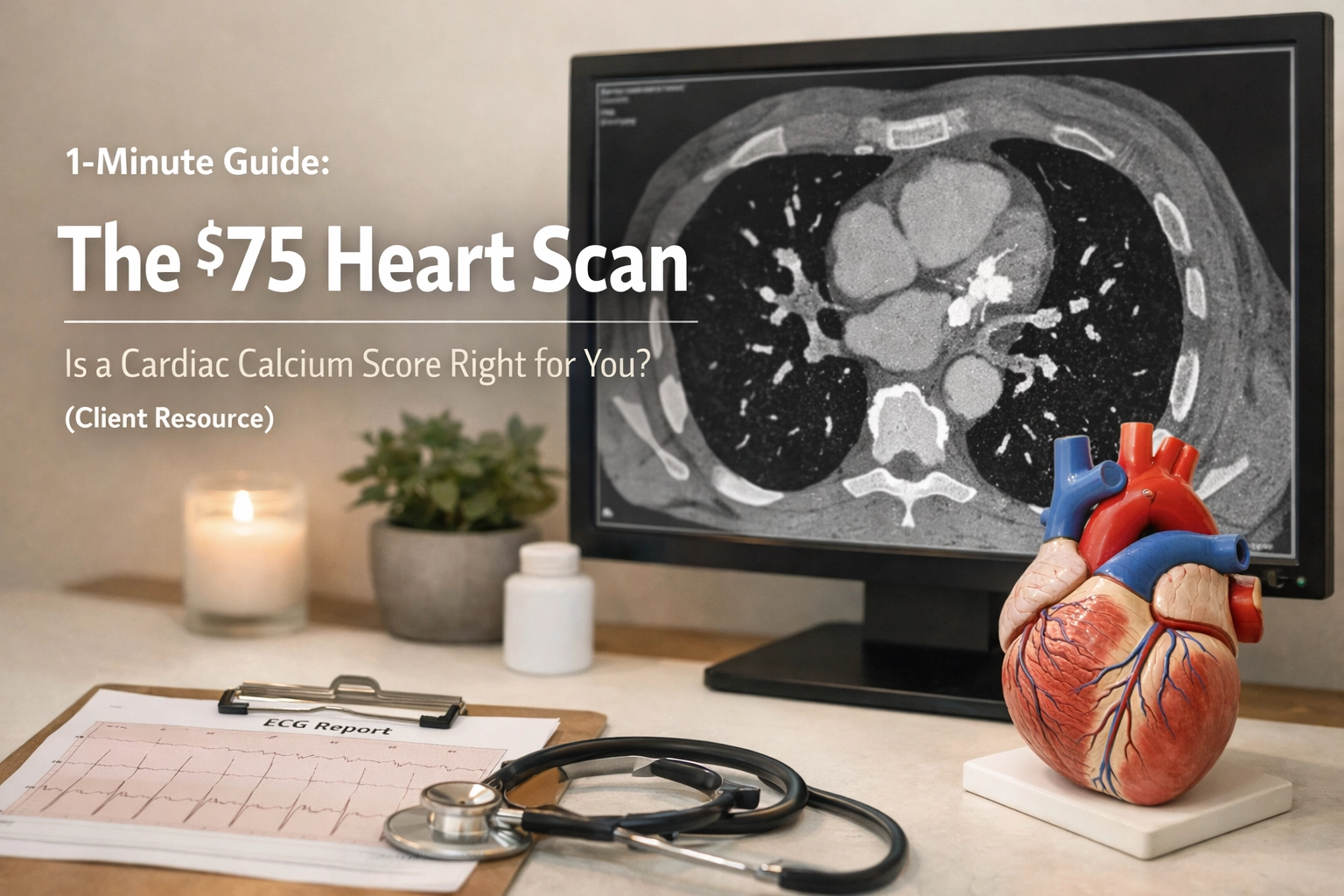

Your doctor says your cholesterol is “borderline.” Your dad had a heart attack at 52. You’re somewhere in the middle: not clearly high-risk, not clearly low-risk. So what do you actually do?
Here’s what most people don’t know: you can skip the guessing game and just look inside your arteries. And it costs about the same as a nice dinner out.
Welcome to the Cardiac Calcium Score: a quick, non-invasive heart scan that shows actual plaque buildup in your coronary arteries, not just risk factors or predictions. And this February, The Fatigue Clinic in Collierville is offering it for just $75.
Let’s break down exactly what this test is, who needs it, and why it might be the most important $75 you spend this year.
A Cardiac Calcium Score (also called a coronary artery calcium scan or CAC scan) is a specialized CT scan of your heart that detects calcium deposits in your coronary arteries.
Here’s why that matters: calcium in your arteries = plaque buildup = coronary artery disease.
The test is:
You get a numerical score: called an Agatston score: that tells you exactly how much calcified plaque is sitting in your coronary arteries right now. Not “might be there someday.” Not “based on your cholesterol levels, we think…” But actual, measurable plaque.

Let’s be honest: cholesterol tests are helpful, but they’re not the whole story.
Your cholesterol numbers tell you about risk factors: things that could lead to heart disease down the road. But they don’t tell you if heart disease is already happening inside your arteries.
Think of it this way:
You can have “normal” cholesterol and still have significant plaque buildup. You can have high cholesterol and have completely clear arteries. The calcium score shows you what’s really going on.
Here’s what makes the Cardiac Calcium Score different:
It detects actual disease, not just risk. Calcium in your arteries isn’t a risk factor: it’s evidence that atherosclerosis (hardening of the arteries) is already present.
It personalizes your risk. Two people can have identical cholesterol levels and wildly different calcium scores. The score tells you your specific situation, not population averages.
It changes treatment decisions. A high calcium score might mean you need aggressive intervention now. A zero score might mean you can skip unnecessary medications. Either way, you’re making decisions based on your actual arteries, not statistical probabilities.
For patients in Germantown, Memphis, Arlington, and Collierville, this test offers clarity that standard cholesterol panels just can’t provide.
The Cardiac Calcium Score is most valuable if you’re in the “gray zone”: not clearly high-risk, not clearly low-risk.
Consider getting this test if you:
✓ Have a family history of early heart disease (parent or sibling with heart attack or bypass surgery before age 55 for men, before 65 for women)
✓ Are unsure about starting a statin or other heart medication based on your current risk assessment
✓ Have borderline cholesterol levels and want to know if you actually need treatment
✓ Are between ages 40-75 with intermediate risk factors (high blood pressure, prediabetes, former smoker, etc.)
✓ Want to clarify your true risk level before making decisions about preventive medications or lifestyle changes
✓ Have concerning symptoms but “normal” standard tests
Not recommended for:
✗ Pregnant women (CT scans involve radiation exposure)
✗ People already diagnosed with coronary artery disease (you already know you have it)
✗ Very young adults with no risk factors (extremely unlikely to have calcification)
✗ People with very high risk who already need aggressive treatment regardless of score
At The Fatigue Clinic, we see patients from all over the Memphis area who fall into that frustrating middle category: some risk factors, some family history, but no clear answer about what to do next. The calcium score removes the guesswork.

When you get your results, you’ll see your Agatston score: a number that represents the amount of calcium detected in your coronary arteries. You might also get a percentile ranking that compares your score to other people your age and sex.
Here’s what the numbers mean:
Score of 0 (Zero):
Score of 1-99:
Score of 100-299:
Score of 300+:
Percentile Rankings Matter Too:
If your score is at the 75th percentile or higher for your age and sex, your risk is significantly elevated compared to your peers: even if the raw number seems low.
For example, a 45-year-old with a score of 50 might be at the 90th percentile (worse than 90% of people that age), which is concerning despite the relatively low absolute number.
Here’s the reality: this test typically costs $100-$400 at most facilities. Insurance often doesn’t cover it because it’s considered “screening” rather than diagnostic.
This February, The Fatigue Clinic in Collierville is offering the Cardiac Calcium Score for just $75.
That’s less than most co-pays. Less than a monthly gym membership. About the same as a decent dinner out: except this one might actually save your life.
Why are we doing this? Because we believe in root-cause, preventive medicine. We’d rather help you discover and address heart disease risk before you’re sitting in an emergency room. We’d rather give you actual data to work with instead of just crossing your fingers and hoping your cholesterol numbers tell the whole story.
The special runs through February 2026. Call 901-221-8621 to schedule your scan.

Getting the scan is the easy part. What you do with the results is what really matters.
At The Fatigue Clinic, we don’t just hand you a number and send you on your way. We help you understand what your score means for you specifically and create an actionable plan based on your results.
If your score is zero or very low: We’ll help you maintain those clean arteries with lifestyle optimization, appropriate supplementation, and regular monitoring.
If your score shows plaque buildup: We’ll dig deeper. What’s driving that plaque formation? Is it inflammation? Insulin resistance? Oxidative stress? Nutrient deficiencies? We use functional medicine approaches to address the root causes, not just slap a statin prescription on it and call it done.
Our approach includes:
We serve patients throughout Germantown, Memphis, Collierville, and Arlington who want more than the standard “here’s your cholesterol, here’s your prescription” approach to heart health.
You wouldn’t manage your finances based on hunches. You wouldn’t navigate a road trip without checking the actual map. So why manage your heart disease risk based on statistical predictions instead of looking at your actual arteries?
The Cardiac Calcium Score gives you real information about your real heart. It takes the mystery out of heart disease risk and gives you something concrete to work with.
For $75 this February, you can stop wondering and start knowing.
Ready to see what’s really going on inside your arteries?
Call The Fatigue Clinic at 901-221-8621 to schedule your Cardiac Calcium Score. We’re located in Collierville and proud to serve patients throughout Germantown, Memphis, Arlington, and surrounding areas.
Your heart health is too important to leave to guesswork. Let’s get you some answers.
The Fatigue Clinic | 901-221-8621 | Collierville, TN
Serving Germantown, Memphis, Arlington, and surrounding communities with functional medicine and root-cause healthcare.