
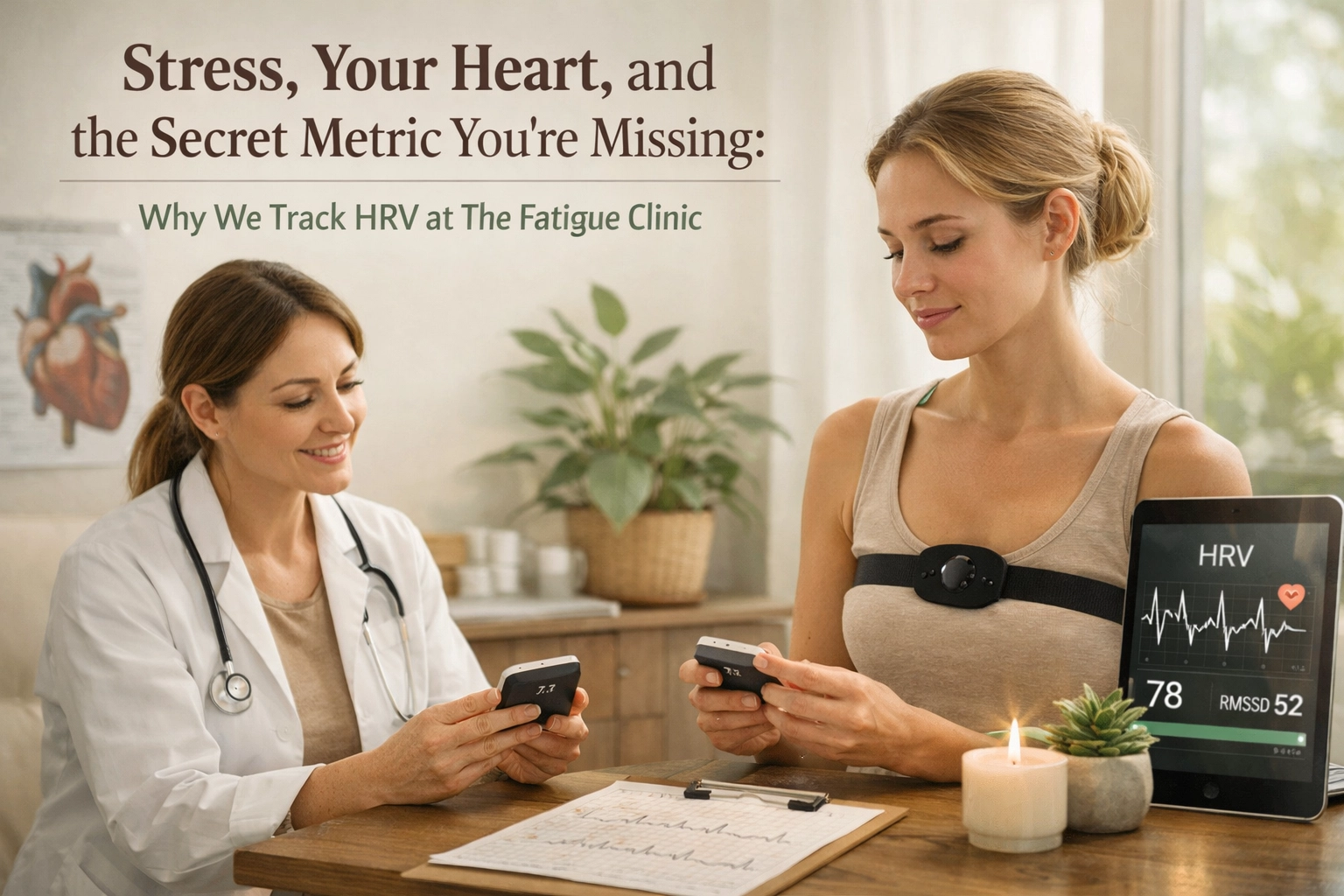
February is Heart Month, and here at The Fatigue Clinic in Collierville, we’re talking about something that most doctors never check: even though it reveals more about your heart health than your resting heart rate ever could.
It’s called Heart Rate Variability (HRV), and if you’ve never heard of it, you’re not alone. Most patients in Memphis, Germantown, and Arlington have no idea this metric exists, let alone that it’s one of the most powerful indicators of how stress is quietly damaging their cardiovascular system.
Here’s what you need to know.
Heart Rate Variability measures the variation in time between consecutive heartbeats.
Your heart doesn’t beat like a metronome: and that’s a good thing. A healthy heart has natural variation in the intervals between beats. One beat might come 0.85 seconds after the last, the next might come 0.92 seconds later. That variability is controlled by your autonomic nervous system, which manages all the automatic functions your body performs without you thinking about them.
High HRV = your nervous system is flexible and responsive. Your body can shift smoothly between “fight-or-flight” and “rest-and-digest” modes depending on what the situation demands.
Low HRV = your nervous system is stuck. You’re locked in a chronic stress response, and your body has lost its ability to adapt and recover.

Most people: and most doctors: track heart rate. That’s fine for basic fitness monitoring. But HRV reveals information that heart rate alone completely misses.
Research shows that HRV can distinguish between physical strain and psychological stress in ways that regular heart rate measurements cannot. Both running a mile and dealing with work stress might raise your heart rate to 120 beats per minute, but HRV shows the type of nervous system activation occurring.
This matters enormously for heart health.
When we measure HRV at our Collierville clinic, we’re looking at metrics like:
These measurements respond predictably to stress: and they’ve been shown to be more sensitive and specific than measuring heart rate changes alone.
Here’s what happens when you’re stressed:
Your sympathetic nervous system activates. This is your “fight-or-flight” response. Your heartbeats become more uniform and less variable. Your HRV drops.
When you’re relaxed, the opposite happens. Your parasympathetic nervous system: the “rest-and-digest” system: takes over. Your HRV increases.
The problem for most patients we see in Germantown and the surrounding Memphis area? They’re stuck in chronic stress mode. Their HRV stays consistently low, day after day, week after week.
This isn’t just about feeling stressed. Persistently low HRV indicates your nervous system remains in a heightened stress state, which directly impacts your cardiovascular system. You’re wearing out your heart.

Low HRV is linked to increased cardiovascular risk. When your heart rate variability stays suppressed, it signals that your body has lost its physiological resilience: your ability to adapt to stress and recover from strain.
Think of it this way: A car that can only run at one speed, with no ability to accelerate or decelerate smoothly, is going to break down faster than a car with responsive, adaptive systems. Your heart works the same way.
At The Fatigue Clinic, we see this constantly with patients dealing with:
Almost all of them have disrupted HRV patterns that reveal nervous system dysfunction and increased cardiovascular stress: even when their regular heart rate looks “normal.”
This is where it gets practical and actionable.
We offer biofeedback training at The Fatigue Clinic, and it’s one of the most effective interventions we have for improving HRV and reducing cardiovascular risk.
Our biofeedback system uses an acoustic mat: a simple, relaxing technology based on Dr. Bartel’s research. There are no physical connections to you. You simply lie on the mat while it delivers specific sound frequencies that help retrain your nervous system.

Patients consistently tell us how relaxing the sessions are. But beyond relaxation, we’re tracking measurable changes in your HRV metrics. We can see: objectively: whether your nervous system is learning to shift out of chronic stress mode and regain its flexibility.
This isn’t guesswork or “just feeling better.” We’re monitoring your physiological resilience and watching it improve through consistent biofeedback sessions combined with the other functional medicine interventions we use at our clinic.
Since this is Heart Month, we’re offering something important for patients in Collierville, Memphis, Germantown, and Arlington who want to take their cardiovascular health seriously.
Our Cardiac Calcium Score screening is just $75 this month.
A Cardiac Calcium Score is a CT scan that measures calcium deposits in your coronary arteries. It’s one of the most accurate predictors of heart attack risk, and it gives you concrete information about what’s actually happening inside your arteries: not just risk factors or estimates.
If you’re concerned about stress, heart health, or cardiovascular risk (especially if you have family history, high blood pressure, or other risk factors), this is the screening you should get.
Combined with HRV monitoring and functional medicine interventions, you get a complete picture of your heart health: and a real plan for protecting it.
When your HRV improves, here’s what patients report:
These aren’t just subjective improvements. They reflect measurable changes in how your nervous system and cardiovascular system are functioning.
Your body is adapting better. Your heart is working smarter, not harder. You’re building resilience instead of burning it down.

Most functional medicine practices in the Memphis area don’t track HRV at all. Traditional cardiology practices might check your resting heart rate and blood pressure, run an EKG if they’re concerned, and send you home.
That’s not enough.
At The Fatigue Clinic, we’re looking deeper. We’re tracking the metrics that reveal what’s actually happening with your nervous system and cardiovascular health: and we’re using interventions like biofeedback that can actually change those metrics for the better.
We serve patients from Germantown, Memphis, Arlington, and throughout the surrounding areas who are tired of surface-level care and want real answers about their health.
You can’t fix what you don’t measure. And you can’t protect your heart health if you’re only tracking basic metrics that miss the deeper picture.
HRV monitoring gives you that deeper picture. It shows you how stress is impacting your cardiovascular system in real-time. It reveals whether your body has the resilience to handle the demands of your life: or whether you’re slowly wearing yourself down.
And when you combine HRV tracking with interventions like biofeedback, functional medicine testing, and targeted support for your nervous system, you can actually reverse the damage and rebuild your resilience.
That’s what we do at The Fatigue Clinic in Collierville.
If you’re dealing with chronic stress, fatigue, sleep problems, or any health condition that’s wearing you down: and especially if you’re concerned about your cardiovascular risk: call us at 901-221-8621 to schedule a heart health evaluation.
We’ll assess your HRV, discuss whether biofeedback is right for you, and create a personalized functional medicine plan that addresses the root causes affecting your heart and overall health.
And don’t forget about our $75 Cardiac Calcium Score special this month. It’s the most accurate way to know your actual heart attack risk: and it’s available right now for patients in the Memphis area who want real information about their cardiovascular health.
Call 901-221-8621 today. Your heart: and your HRV( will thank you.)